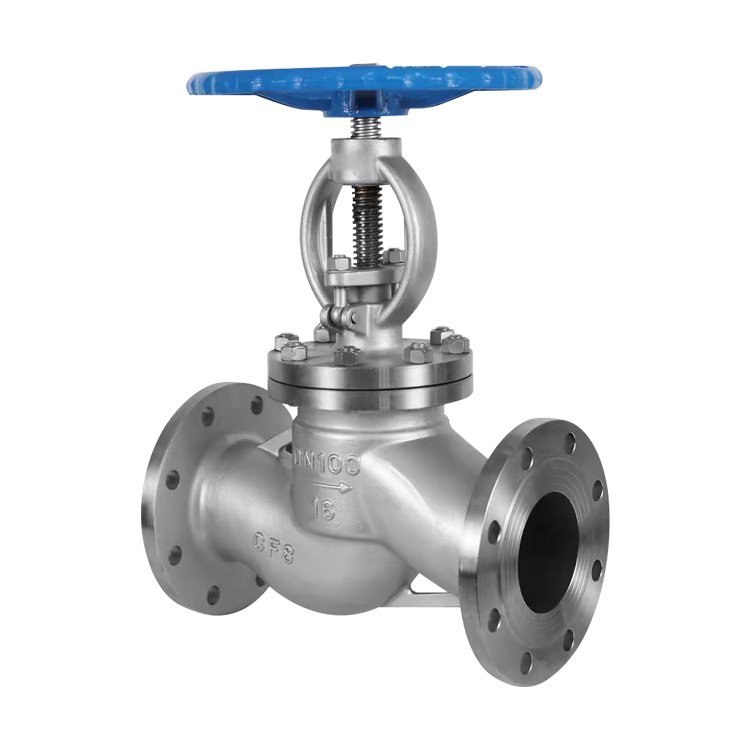
Straight-pattern flanged configuration
Use the offered drawing to compare installed length, both mating ends and overhead access. Confirm the material schedule by component.
Compare stainless steel globe valve arrangements for industrial piping. Specify wetted components, connection dimensions and the required throttling or shutoff duty.
Request a quoteUse the offered drawing to compare installed length, both mating ends and overhead access. Confirm the material schedule by component.

Check inclined operator clearance, flow direction and model-specific pressure loss for the intended duty.
Stainless steel globe valve selection starts with the process medium and the material schedule for the whole assembly. Specify the body and bonnet grades, then review the disc, seat, stem, packing and gasket. Include actual fluid composition, concentration and temperature, plus cleaning or stagnant conditions that can affect compatibility. A casting grade such as CF8 or CF8M belongs to the material specification for a particular component. Check the trim and pressure-temperature rating for the offered model as separate requirements.
A straight-pattern body fits an in-line spool, while a Y-pattern body places the stem at an incline. Verify the flange interface, face-to-face length and operator access in either layout. For an inclined operator, check the sideways clearance during stem travel and servicing. If flow regulation is the main duty, send minimum, normal and maximum flow and corresponding inlet and outlet conditions. Put the required shutoff differential and leakage acceptance on the inquiry as well.
| Item | Send with your inquiry | Check on the offer |
|---|---|---|
| Materials | Fluid chemistry, temperature and required grades by component | Body, bonnet, disc, seat, stem and non-metallic components |
| Flow duty | Flow range and pressures, or closed-valve differential and leakage criterion | Model flow data, trim, required flow direction and test basis |
| Installed fit | Flange details, installed length and operator access | Dimensioned drawing and full stem and operator envelope |
| Documentation | Material traceability, test record and any witness points | Quoted inspection and document scope with exceptions identified |
Compare the actual configuration and document package rather than the stainless designation alone. If corrosive service drives selection, identify the wetted components that require specific grades or traceability. If a supplier proposes an alternative grade, body pattern or trim, request the technical basis and written deviations before purchase. That makes the comparison useful to engineering, maintenance and purchasing.
Review the selection question and confirm the offered drawing, materials and requirements with your inquiry team.
Start with the project piping specification and the actual chemical, pressure and temperature conditions. Provide concentration, cleaning data and standby exposure. Ask for the offered grade and product form by component, including the body casting and trim. Check the seat, packing and gasket separately for the full service.
Compare the mating flanges, face-to-face length, model flow data and service rating. Check the space occupied by the inclined stem and handwheel. Ask for an approved drawing, required flow direction and clearance for operation and maintenance before ordering.
Review metal and non-metal wetted components individually. A stainless body does not identify the seat, disc, stem, packing or gasket supplied. Share the process chemistry and cleaning exposures and ask for a component material schedule and compatibility review.
Provide flow at minimum, normal and maximum conditions, with the corresponding upstream and downstream pressures and fluid temperature and phase. Ask the supplier to evaluate the offered trim across the operating range, including any required limits on noise or cavitation.
Specify which components require material certification and traceability, then list the pressure and leakage tests required on the order. If inspection must be witnessed, identify the acceptance criteria and hold points. Ask the supplier to tie the proposed records to each valve tag.
Send the required size, process duty, installation dimensions and quantity.