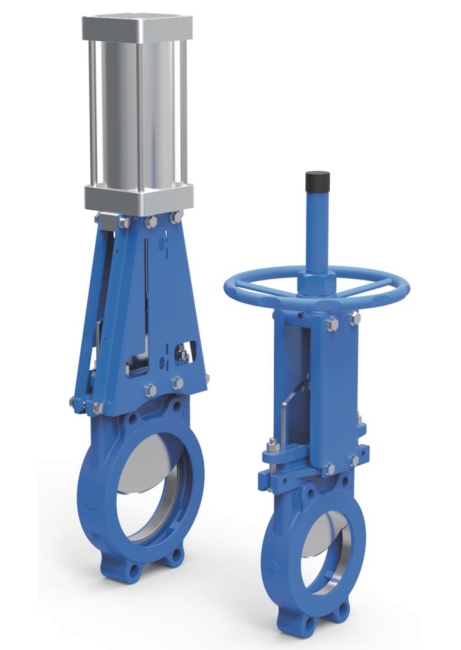
QB unidirectional arrangement
Mark the pressure side of the closed valve on your drawing and confirm the rated sealing direction for the quoted assembly.
Compare QB and QM pneumatic knife gate valve options for industrial isolation. Define sealing direction, available air pressure and the response required on utility loss.
Request a quoteMark the pressure side of the closed valve on your drawing and confirm the rated sealing direction for the quoted assembly.
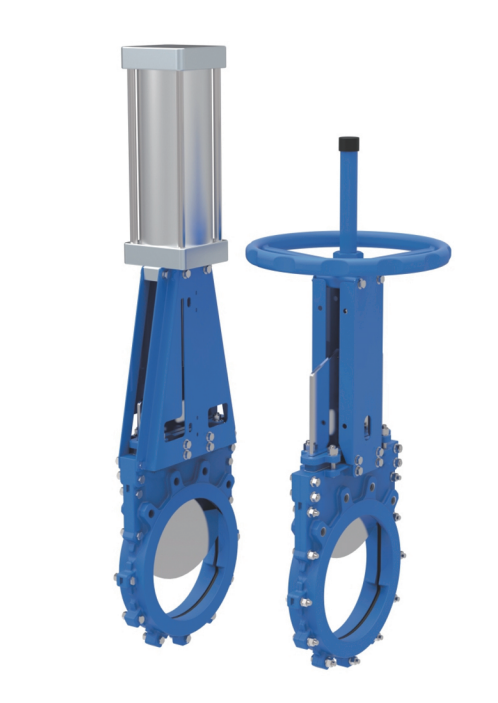
Include the closed-valve differential and leakage requirements in both directions, together with the operating loads for cylinder sizing.
A pneumatic knife gate valve moves a sliding gate using an air cylinder. The gate and seat are selected for the process duty, while the cylinder and controls are selected for the load, speed and required behavior. Give the minimum air pressure at the cylinder during travel and the opening and closing differentials. For slurry or pulp, describe whether material settles across the gate or builds up after idle periods. The cylinder needs to be reviewed with the actual gate and seat against that load.
The QB series is a reference for one specified sealing direction, and the QM series is a reference when the project needs shutoff against pressure from either side. Confirm permitted direction and differential on the proposed drawings and test scope. Check the full assembly height, orientation, mounting support and service access, including the air lines, control fittings and clearance for the complete stroke.
| Item | Send with your inquiry | Check on the offer |
|---|---|---|
| Valve duty | Media, solids, sealing direction and differential | Body, gate and seat material schedule and shutoff rating |
| Air supply | Minimum pressure while stroking, air quality and simultaneous demand | Cylinder selection and the basis for required stroke time |
| Controls | Signal, power, air-loss response and position feedback | Solenoid, switches, pneumatic drawing and documented fail action |
| Fit and scope | Valve dimensions, available height, flange details and mounting position | Assembly layout, support requirements and accessories included |
When comparing air-operated packages, compare the valve and cylinder together and list separately any controls or site-supplied parts. Ask for opening and closing time under the stated conditions, particularly when more than one valve operates at the same time. Where shutoff or fail response is critical, define the acceptance steps before approving the purchase.
Review the selection question and confirm the offered drawing, materials and requirements with your inquiry team.
Specify the required position or behavior under air loss, signal loss and electrical loss separately. A double-acting cylinder uses air for both strokes. Its response depends on the complete circuit and gate load. Ask for the proposed circuit, stated limitations and any acceptance tests needed to verify fail behavior.
State minimum available pressure at the actuator while it is moving, plus normal and maximum supply pressure. Include line losses and simultaneous demand if known. Ask the supplier to document cylinder sizing and response under the expected process and air conditions.
Consider it when the process requires shutoff with pressure on either side of the gate during normal operation, shutdown or cleaning. State the differential and allowable leakage in each direction. Confirm the offered model and test procedure against those conditions before buying.
Specify the accessory scope on the RFQ. Include supply voltage, signals, enclosure or approval requirements, connection details and any manual override. Ask for a component list and drawing to show what is delivered assembled and what the installation team must supply.
Provide the existing model, valve tag, stroke and mounting dimensions, plus the condition of the gate and seat. Ask the supplier to review thrust, compatibility and support. Verify the proposed coupling, travel limits and available space on an assembly drawing before ordering.
Send the required size, process duty, installation dimensions and quantity.