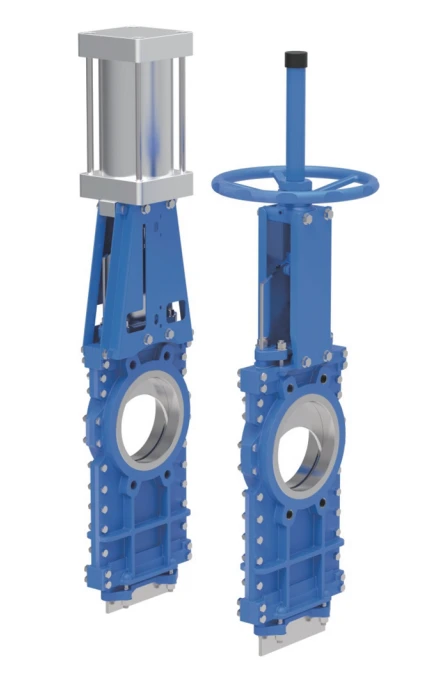
QC Series manual and cylinder layouts
Compare the complete outline for your selected operator, including travel, supports and the location of access points.
Review the QC Series through-conduit knife gate valve for solids-bearing isolation. Check the open passage, bidirectional shutoff conditions and gate travel against your line before requesting a quote.
Request a quoteCompare the complete outline for your selected operator, including travel, supports and the location of access points.
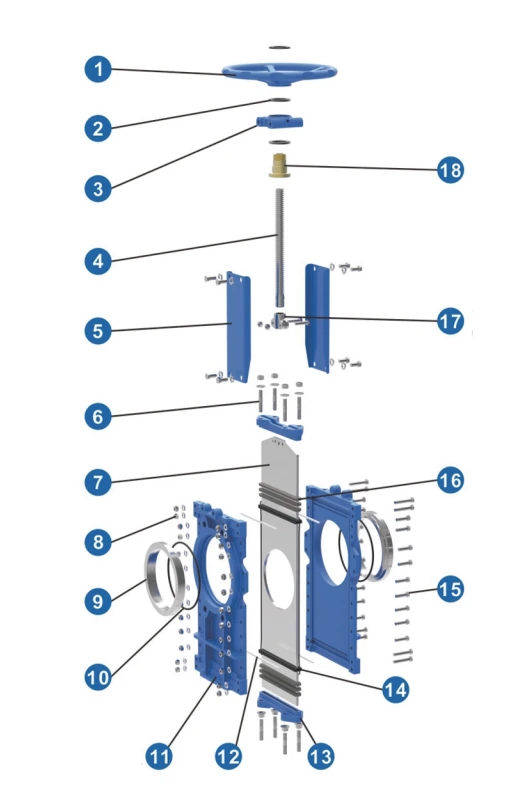
Use the sectional or exploded drawing to identify wear parts, packing and access. Request the parts schedule for the offered model.
A through-conduit gate uses an opening in the moving gate that aligns with the pipeline when the valve is open. Compare the actual open bore and the gate path with the pipe and its lining. Use process information to drive the review. Share the particle or fiber size, concentration, carrier fluid, temperature and settling behavior during idle periods. If flushing is part of the site's operating sequence, include its fluid and timing. Ask which surfaces and seals are exposed so wear and material compatibility can be considered before choosing the assembly.
If pressure can reach the valve from both ends, list the maximum differential and allowable leakage for each direction. For QC Series inquiries, verify the wafer interface, face-to-face dimension and bore on the offered drawing. Check the full envelope above and below the pipe, including the moving gate, operator and any access required for packing and wipers. For a cylinder-operated unit, give the available supply, frequency and required stroke time. Include any controls, shielding or position feedback the site needs.
| Item | Send with your inquiry | Check on the offer |
|---|---|---|
| Open passage | Pipe bore, liner shape and expected solids or fibers | Gate opening dimension, passage geometry and exposed materials |
| Double-direction duty | Closed differential and leakage by pressure side | Seat arrangement and test scope in the required directions |
| Gate envelope | Space above and below pipe and near adjacent equipment | Full-travel outline, support and service access |
| Operation and parts | Cycle frequency, supply, spare scope and documentation | Operator proposal, packing and wear-part list and drawing |
Send Val-Man a line sketch, media data and the conditions under which the gate must close. If maintenance history is available, say whether the current issue involves packing leakage, seat wear or solids build-up. A quote tied to those conditions can include the correct layout, test scope and spare-parts information.
Review the selection question and confirm the offered drawing, materials and requirements with your inquiry team.
The moving gate includes an opening that lines up with the flow passage when open. Check the offered section and bore to see how it fits your pipe. The passage arrangement should be reviewed together with expected solids, sealing directions and the space available for full gate travel.
Ask for the allowable differential and acceptable leakage for each pressure direction on the offered size and seat configuration. State both pressure cases on the inquiry and request the applicable test evidence. That gives the purchase and inspection teams a common basis for acceptance.
Confirm flange drilling, installed length, clear bore and gate travel against the existing installation. Include nearby supports, floor clearance and maintenance access in the sketch. Compare sealing and operator requirements at the actual differential and media conditions before approving the substitution.
Give the solids or fiber concentration, particle or fiber size, carrier liquid, temperature and chemistry. Describe whether the medium settles, bridges or thickens and when the line is flushed. Ask for the proposed seat, gate, packing and wear-part materials for those conditions.
Ask for the wear and sealing components tied to the exact valve configuration. Check the availability of seats, packing, scrapers or wipers and any items replaced during disassembly. Request part identifiers, material and quantities by tag so future orders can be matched to the installed assembly.
Send the required size, process duty, installation dimensions and quantity.